Commodity sourcing intelligence
Find credible buyers and suppliers in fragmented raw-material markets
OxyLens maps the companies and sites that buy, sell, trade, produce and handle feedstocks and by-products, and keeps the public evidence behind every role. It is built for physical traders and sourcing teams who need counterparties, not headlines.
The problem: the market map lives in fragments
In by-product and feedstock markets there is no exchange and no complete directory. Who actually takes a tanker of crude glycerine, category 3 fat or acid oil is scattered across:
Registers and certificates
Company registers, ISCC certificates, animal by-product approvals and REACH registrations. They show permission, not appetite.
Company pages
Product sheets, "we buy" pages and feedstock desks. They are the best commercial signal, but written differently in every country.
Trade statistics
Customs codes give country flows and origins, but never tell you which company is behind them.
People's heads
Traders know their own book. They rarely know the rest of the chain in a neighbouring commodity or country.
What OxyLens does
Supplier discovery
Collectors, producers, splitters, refiners and traders that can actually offer the material, at the scale that matters.
Buyer discovery
Plants and traders whose own public evidence shows they take the material, sorted into buyer types that want different specifications.
Facility intelligence
Sites are tracked separately from the companies that own or operate them, with location precision stated honestly.
Cross-commodity relationships
One company in several markets, role reversals and coproduct chains, such as fat splitting that yields both fatty acids and glycerine.
Evidence-backed qualification
Every role is a sourced statement marked as fact, inference or unknown, so you can see what is proven before you call.
Geographic view
Sites on a map, with possible supply lines drawn as possibilities, never as trades.
How it works, in four steps
- Public sources. Registers, certification databases, regulatory lists, company websites, safety data sheets and customs classifications.
- Canonical companies and facilities. One legal person and one site each, keyed on registry identifiers where possible. Related companies are linked, never silently merged.
- Evidence. Each buy, sell, trade, produce or handle role is recorded as fact, inference or unknown, with its source.
- Commercial opportunities. Explainable leads such as a company active in two markets or two sites that could supply each other. They are leads to qualify, not deals.
Markets OxyLens currently researches
Five connected commodities, researched across selected European markets. Coverage is growing, not exhaustive.
Used cooking oil (UCO)
Collecting points, traders with storage, pretreatment, and FAME, HVO and co-processing buyers.
Animal fats
Category 3 technical fat: renewable-feedstock traders, fuel plants, oleochemical and technical-fat processors.
Glycerine
Crude, technical and refined grades, and the refiners, chemical plants, biogas and feed outlets behind them.
Free fatty acids
Acid oil, fatty acid distillates and distilled fatty acids: three products, three sets of buyers.
Monopropylene glycol
Producers, distributors and importers, and which of them can really sell you a tanker.
Why this is not a directory
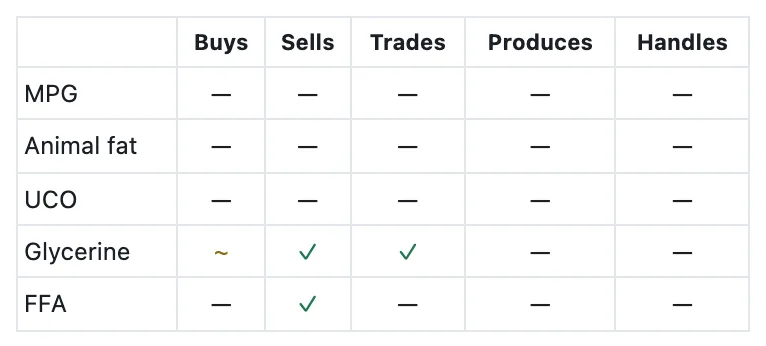
Directories list names. OxyLens keeps four distinctions that decide whether a call is worth making.
Public intelligence today, your own history later
OxyLens is built so that a company's private trading history can later sit on the same company and facility records as the public evidence, kept separate and visible only to that company. That would turn market intelligence into customer-specific opportunities. This is the product direction, not a feature available today: current OxyLens uses public evidence only.
Using OxyLens
OxyLens is a private web application in active use. Access is password-protected.